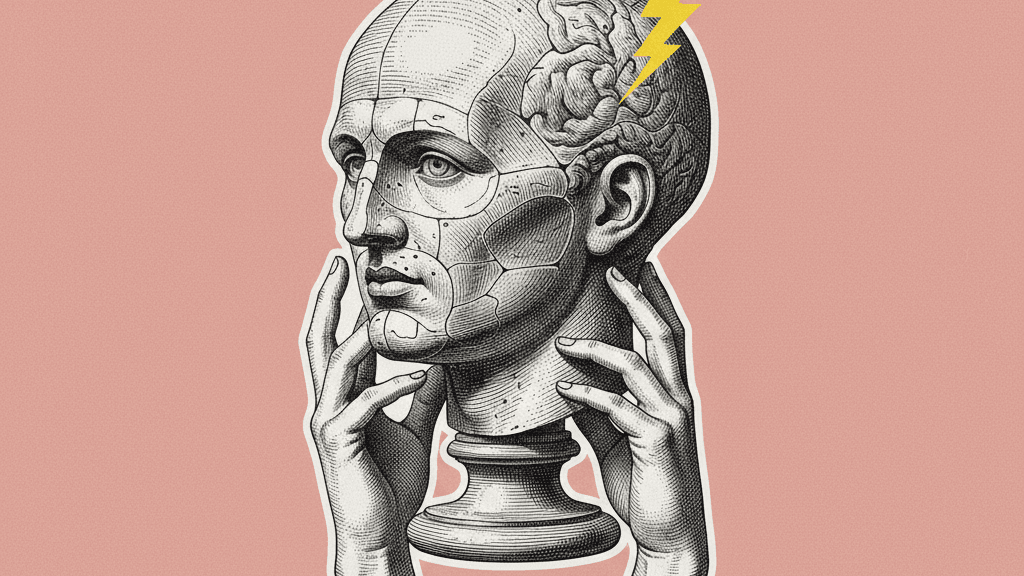
Facial semiology with AI: how I prepare teaching images with Gemini and MediaPipe
In my naturopathy courses, I teach facial semiology. It is an old, subtle practice that demands precise visual supports. I used to spend evenings hunting for royalty-free photos, drawing annotations on top, redoing them when the quality did not hold.
Today, I have a pipeline that generates plates in minutes. A teaching image, clean, annotated in the right places, usable in class or in an article. Nothing has replaced my teaching, but the preparation of supports has moved into a different world.
The problem
Facial semiology is fine observation. To teach it, you need images that show precisely what to look at. Circles under the eyes, folds, the color of a zone, the shape of a line. Without annotations, a photo is useless: a beginner's eye does not know where to look.
The problem is that most stock banks offer photos not designed for this. Poor lighting, too-wide cropping, or stylized portraits that erase relevant details. Even when I found the right photo, manual annotation took one to two hours per plate.
There is also a rights problem. Teaching demands squareness on image origin. Using a photo found online without a clear license is out of the question, especially one showing a face.
What I set up
A two-step pipeline.
Image generation with Gemini. I ask Gemini to produce a fictional face, built for teaching. I specify the approximate age, lighting, angle, and most importantly the features to make visible: marked circles, dull complexion, left-right imbalance, whatever I am teaching that day. The output is an image that matches no real person. It is a case study, which is exactly what is needed.
Landmark detection with MediaPipe. On top of the image, a facial detection tool places precise landmarks. MediaPipe identifies hundreds of points on a face: eye contours, cheek zones, nose ridges, lip lines, chin contour. I retrieve those coordinates and can position my annotations accurately, without measuring by hand.
An annotation script. A small script reads the landmarks, applies my typographic annotations (arrows, labels, contrast zones) and exports the plate in high definition. The visual style is locked once: I do not waste time recomposing an aesthetic for each plate.
A teaching review. I never publish a plate without checking it. Annotations must be accurate. An error in semiology is an error that then replicates in students' heads. This human step is non-negotiable.
The result
A plate that used to take me about ninety minutes now takes less than ten. Across a course preparation cycle, that changes everything. I can build a rich support with ten or twelve plates without sacrificing a week.
I can also produce plates specific to a case. During a class, a student asks a precise question about a presentation I had not prepared. I rerun the pipeline within the hour, send them the plate, and they leave with a visual answer to their question. That was impossible before.
And I work calmly on rights. Every image is generated for the course. No privacy is at stake. No stock bank to license. My support is entirely mine, traceable, reusable without limits.
How you can replicate this
This case is specific to semiology, but the principle extends to any teaching that needs annotated, consistent images. Anatomy, posture, gesture, technical observation, visual diagnosis in professional fields. Anywhere an image is the heart of the course.
Start by defining your standards. Which size, which format, which palette, which annotation style. Without that brief, you will produce plates that do not match and your course will lose readability.
Choose an image generation model that accepts your type of prompt. Not all are equal on faces. Test three or four cases before committing to a full pipeline.
Automate annotations, not interpretations. The pipeline can draw an arrow in the right spot. It must never write in your place what the arrow means. That is your teacher's work and must stay yours.
A firm rule. Do not generate an image of a real person without their consent, even for teaching. Never process a client's image without explicit written permission and a clear commitment on what you will do with it. That rigor protects your students, your practice, and your reputation.
If you want to set up this kind of pipeline for your own teaching, I can support you.
Read next
- Pre-consultation questionnaires what happens before the face reading.
- Naturopathy chatbot on my site: guardrails for AI to see AI at work on the website side.
- Preparing naturopathy school courses with Claude to teach the method, not just use it.
— François