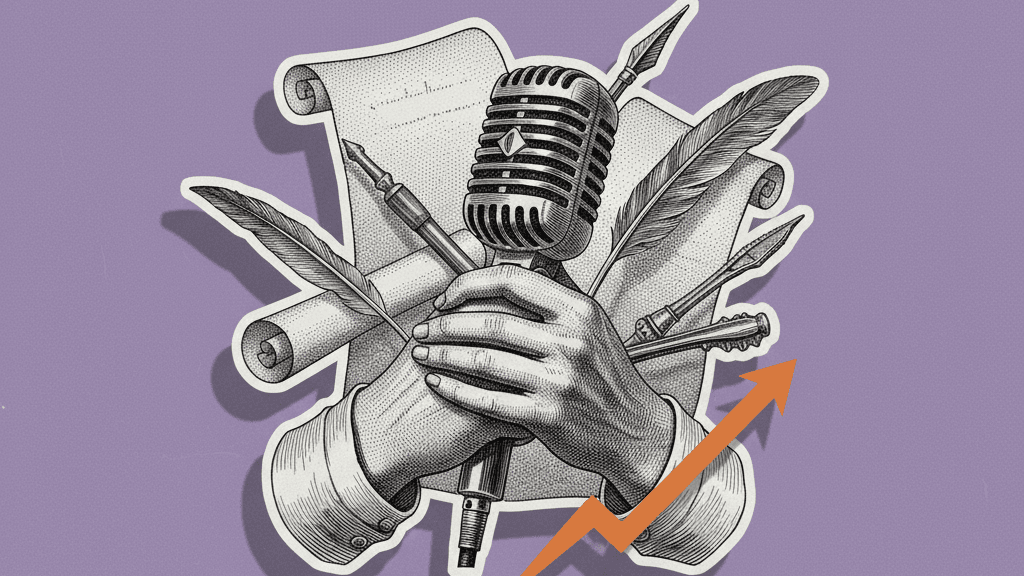
From a podcast to a newsletter, an article and posts: recycling a recording with AI
I record podcast episodes regularly. An hour of conversation or monologue, prepared but alive. For years, that recording lived only once: released, listened to by part of my community, forgotten the following week.
Today, one episode fuels seven days of written production. Newsletter, blog article, social posts, video clips. Not by magic. Through a simple pipeline that Claude drives.
The problem
Podcasts are a demanding format. They take a lot of energy to prepare, record, edit. Once published, their real shelf life is three or four days on the platforms. After that, they sink into the archive and only surface again if someone stumbles onto them.
Meanwhile, the other formats I publish each demand their own writing time. A blog article takes two hours. A newsletter, one hour. A carousel, another hour. Add it up, and a week of writing is at least ten hours.
I was facing an absurd choice. Keep the podcast and sacrifice the writing, or keep the writing and slow down the podcast. Neither was acceptable, because I have an audience that expects both.
What I set up
A pipeline that starts from audio and pulls everything else out, without betraying the original style.
Clean transcription. As soon as the episode is recorded, I run a transcription. Not raw, but cleaned: fillers removed, sentences paragraphed, punctuation corrected. The transcript is the source material for everything downstream.
A blog article that does not feel recycled. Claude reads the transcript and proposes an article with a blog structure: title, lead, sections, examples. Explicit instruction: keep my phrasings, my images, my examples. Invent nothing. Smooth nothing. My tone holds because the material is already mine.
A newsletter that reads in five minutes. Same transcript, different prompt. Claude extracts what fits in a short, personal letter with one sharp angle. Not a summary, a point of view. This is a discipline: the newsletter is not a teaser for the article, it has its own life.
Social excerpts. From the same transcript, I pull ten to fifteen passages that stand on their own. Each can become a post, a carousel, or a subtitled video clip. I schedule them across the week, varying formats.
A validation discipline. Nothing ships without me reading it. Five to ten minutes per format. I cut, I rewrite three or four sentences, I approve. I never let the AI publish for me.
The result
A podcast episode today feeds seven days of publishing. Across a year, that changes the very nature of my editorial pace. I am no longer in chronic urgency: I am in the harvest.
Weekly writing time is cut by three. What took me eight to ten hours now takes two to three. The rest goes into consultations, preparing the next episodes, and above all rest, which is the backbone of quality over time.
The least expected benefit is consistency. Because all formats come from the same recording, they echo each other. Someone who reads the newsletter, listens to the episode, and stumbles on a post finds continuity. Before, I was juggling three voices without noticing.
How you can replicate this
You do not need to podcast for this system to serve you. Any regular recording can be the source: a live, a workshop, a training, an anonymized client call, an internal conversation. What matters is a rich, recurring oral material.
Start with transcription. It is the invisible but central piece. A good transcription makes the whole pipeline work. A mediocre one cannot be saved by any prompt. Do not cut corners here.
Then write one prompt per format. Not one prompt that produces everything at once. One per format. The pipeline is slower but a thousand times cleaner. You keep control of each output, you adjust them independently.
Enforce a rule: preserve original phrasings. Claude tends to smooth. You must explicitly ask it to keep your images, your deliberate repetitions, your vocabulary. Signature is often in the small deviations from clean.
Finally, plan. A pipeline is a discipline. Without a calendar, publications pile up or slip away. For me, Monday morning I prepare the week, and everything is set for the days ahead. For you, it will be another moment. Find it.
If you want me to help you build this pipeline with your own material, I can accompany you in one or two sessions.
Read next
- Instagram carousels from my naturopathy courses same logic, applied to teaching.
- Steering your content with Analytics and Search Console to pick which episode to recycle first.
- Granola and Claude: my second brain to capture what's said before it even hits the mic.
— François